
Chief hadn’t arrived yet…
- shashwatsangati
- Apr 9, 2025
- 3 min read

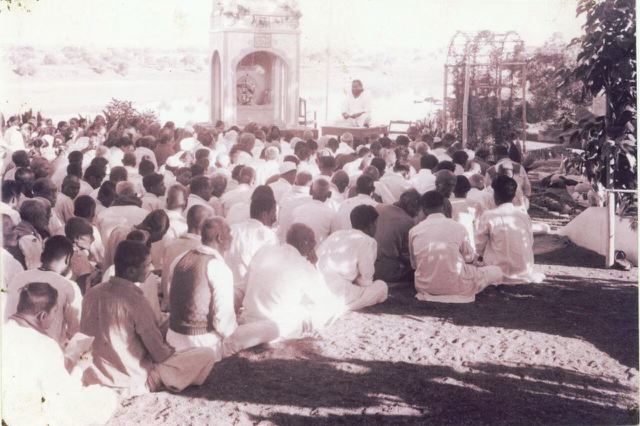
This is a story about the Sadhana Saptaha, which was an annual, week long, spiritual program in Machnur.
Every day, during the Sadhana Saptaha, Saint Baba Maharaj Arvikar would deliver a discourse, which was an outpour of devotion or bhakti, a narration of Lord Ram.
On the left of Baba’s seat (asan), there was a seat prepared for Lord Maruti. On it, there was a big garland. All saints believe that wherever a narration of Lord Ram is shared, Lord Hanuman will be there.
Usually for each discourse on the Ramayana, Baba would sit, recite the Gurustavan, then turn to look at Lord Hanuman’s seat on the left and smile for a second before switching his attention to the eager listeners and would then begin his narration of Lord Ram.
On one occasion, it so happened that Baba sat down, recited the Gurustavan, and turned to look at Lord Hanuman’s seat. Four, then eight minutes passed, but Baba didn’t turn back to face his audience. The listeners then started to murmur and talk amongst each other. They started to wonder, why has Baba paused and not started his discourse? Thinking that Baba might be restless, all the the listeners also became restless.
It was at that moment that Baba smiled. He then turned to face the listeners and began his discourse, a narration of Lord Ram. With his divine, melodious voice, he narrated Saint Tulsidas’ speech (vani). As always, the listeners were mesmerized.
The discourse was concluded by singing the name of Lord Ram.
Later, Mr. Thavare, one of the listeners, went to Baba’s room, did a sashtanga namaskar to Baba, and with utmost respect and propriety asked, “Baba, was something on your mind before you began today’s discourse?”
Baba, while patting Mr. Thavare on his back, said, “Chief hadn’t arrived yet. Until Hanuman Ji comes, the narration of Lord Ram cannot begin."
In a discourse on the Ramayana, Baba once said that Lord Ram took on this incarnate (avatar) and Lord Ram’s biography was sung. Ram is the ultimate happiness and bliss. This true bliss is firmly planted in all of us, but we are not all consciously aware of this truth.
Saints sang these virtues of Ram and placed them before us. Saints want to teach us the lessons and paths to manifest Lord Ram in our time, without having been in his [Lord Ram’s] era ourselves.
Ram—he is the blissful essence of our soul, atmaswaroop sohala. Sita, Janaki—she is our intellect or our buddhi. Dasharath represents a mind that faces Lord Ram, where devotion resides.
The mind that manifests Lord Ram, through worship with our ten senses¹, when that mind’s dharma will illuminate the divine as the purpose of life, then the mind has Dashrath’s nature.
There is another mental state, which is that of Lord Hanuman. Hanuman is also a mind. But what is this mind like? It is a mind or state of courage. There is an arrangement and accommodation for the heart of Ram. It is the spread and epitome of the power of Lord Ram. The flame that is the essence of Ram in Ram’s heart, whoever, within themselves, has made that flame foundational, that devotee is Hanuman.
¹5 Dnyanendriyas or cognitive senses of smell, taste, touch, sight and hearing, as well as the 5 Karmendriyas or active expressions of excretion, reproducing, moving, grasping and speaking.


Comments